Over the total life of a project, stainless is often the best value option.

The many unique values provided by stainless steel make it a powerful candidate in materials selection. Engineers, specifiers and designers often underestimate or overlook these values because of what is viewed as the higher initial cost of stainless steel. However, over the total life of a project, stainless is often the best value option.
Lower alloyed grades resist corrosion in atmospheric and pure water environments, while high-alloyed grades can resist corrosion in most acids, alkaline solutions, and chlorine bearing environments, properties which are utilized in process plants.
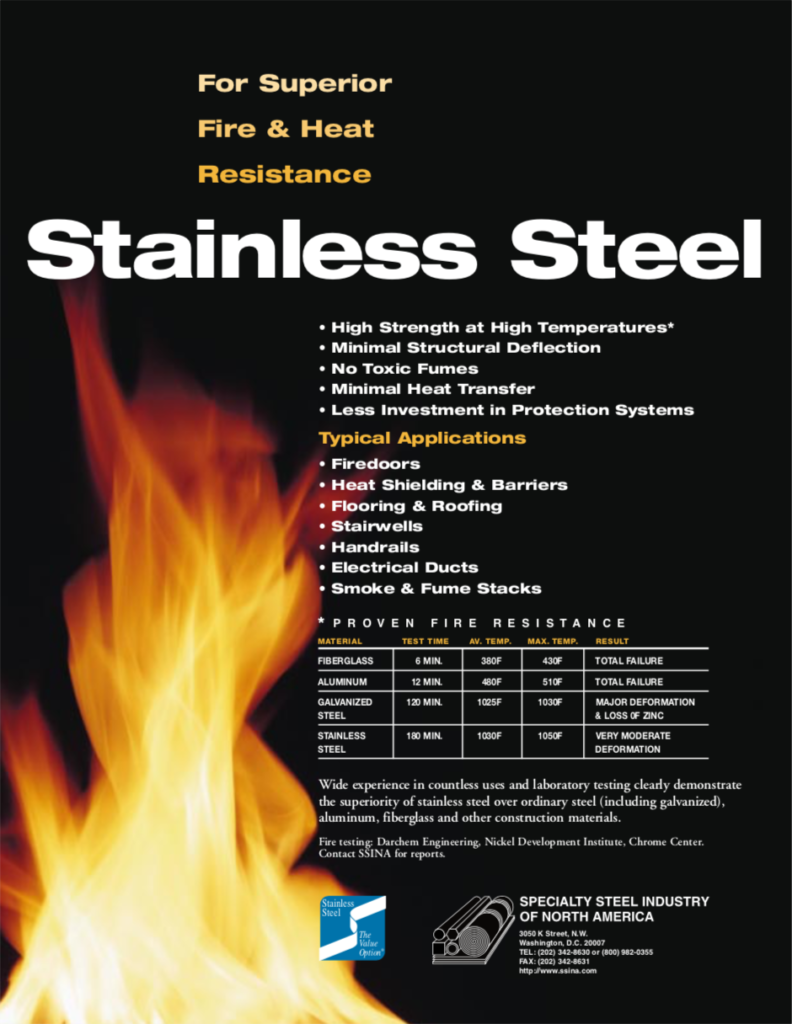
Special high chromium and nickel-alloyed grades resist scaling and retain strength at high temperatures.
The easy cleaning ability of stainless makes it the first choice for strict hygiene conditions, such as hospitals, kitchens, abattoirs and other food processing plants.
The bright, easily maintained surface of stainless steel provides a modern and attractive appearance.
The work-hardening property of austenitic grades, that results in a significant strengthening of the material from cold-working alone, and the high strength duplex grades, allow reduced material thickness over conventional grades, therefore cost savings.
Modern steel-making techniques mean that stainless can be cut, welded, formed, machined, and fabricated as readily as traditional steels.
The austenitic microstructure of the 300 series provides high toughness, from elevated temperatures to far below freezing, making these steels particularly suited to cryogenic applications.
When the total life cycle costs are considered, stainless is often the least expensive material option.
Stainless steel is one of the most sustainable material choices available to decision makers.
As with most stainless steels, tools for machining it need a high positive rake, sometimes as high as 30º, and preferably a chipbreaker.

There are five basic categories of stainless steel: austenitic, ferritic, martensitic, precipitation hardening, and duplex.
Austenitic is a chromium, nickel, and manganese alloy and is identified as 200 and 300 series, according to Kennametal. Grade 304 is the most common, known for great ductility, and can have a tensile strength of 80,000 psi (560 MPa) or greater. As with most stainless steels, tools for machining it need a high positive rake, sometimes as high as 30º, and preferably a chipbreaker. Austenitics also need a high chip load, and an adequate lubricant flow to carry off the heat. The metal’s low thermal conductivity can cause chip build up at the tool tip.
Machining austenitics generates tough, stringy chips. Shallow cuts are difficult because of the metal’s tendency to work harden,
Ferritic, the 400 series, has chromium as the primary alloy. It has a higher machinability than austenitic but a lower ductility than 200 and 300 steels. It has slightly less tensile strength than the austenitics and needs a less positive tool rake. The metal is also less prone to work hardening during machining.
Martensitic is also a 400 series stainless but with less chromium and more carbon than the ferritic steels. It needs heat treating to increase hardness. In fact, it depends on heat treating for hardness and strength. According to Kennametal, tensile strength can be as high as 300,000 psi (2100 MPa), and it is free machining in its non-heat-treated condition. Ductility falls upon heat treating, whereupon machining may require a negative tool rake.
Both ferritic and martensitic machining generates brittle, stringy chips, and work hardening may be a problem.
Precipitation hardening is a small group of steels with high chromium and nickel content. These metals harden by aging and have characteristics close to the martensitic steels, particularly the machinability. Tensile strength might be around 160,000 psi (1120 MPa).
Duplex is comprised of an austenitic and ferrritic metallurigical structure (iron, chrome, nickel, molybdenum, nitrogen). These grades are stronger and more resistant to stress corrosion cracking than the austenitic grades, with better toughness than the ferritic grades.